Sailing from Naples to the Aeolian Islands: 10-Day Catamaran Route
10-day catamaran route from Naples to the Aeolian Islands — Capri, Procida, Salerno, Cetraro, Lipari, Stromboli. Volcanic itinerary for experienced charterers.
Read more

Updated May 2026.
This is the practical 7-day route most catamaran charter guests run on the Amalfi Coast — Naples and the Bay islands across to Capri, then east along the cliff villages to Amalfi and back. An Amalfi Coast catamaran charter is built around short legs and dense scenery: six recognised destinations in a 90-mile arc, with mooring-buoy nights at the marquee stops. The piece below is built from operator experience — which ports to start from, where to anchor versus take a mooring, what each leg costs, and the logistics that surprise first-time charterers on this stretch of coast. If you want the wider Italy picture, the 2026 Italy country guide compares the Amalfi Coast against Sardinia and Sicily.
The Amalfi Coast is a flat-water summer route with limited true marinas, lots of mooring-buoy nights, and tender choreography to cliff-side restaurants. A catamaran handles all of that better than a monohull. The platform sits level at anchor, so the long Positano and Furore nights are calm. Shallow draft (1.2-1.5 m on most charter cats 42-50 ft) lets you tuck closer in at Furore and the small bays under Ravello. Twin engines make the tight inside berths at Capri Marina Grande easier to handle in afternoon traffic. And the deck volume — saloon, bow trampolines, sugar-scoop swim platforms — is a real asset for the lunch-tender-to-restaurant routine that defines this route.
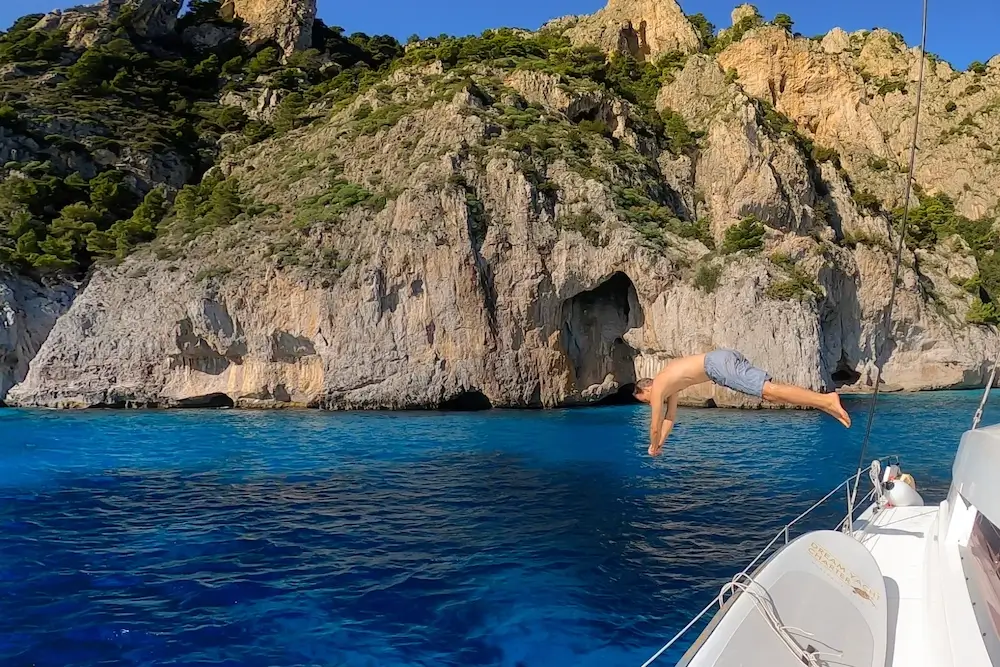
Late May and June are the strongest weeks of the year for this coast: water already warm enough to swim, Capri restaurants open, and the August crowd still six weeks away. July and August deliver hot, settled weather but charter rates peak and Capri restaurants need 2-3 weeks lead time. The Italian Ferragosto holiday around 15 August is the single busiest week — book moorings 2-3 months ahead. September is the operator’s preferred month: water at its warmest, restaurants still open, half the August crowd gone. October is the shoulder — fewer bookings, a small Mistral risk, some restaurants closing for the season.
The Tyrrhenian Sea around the Bay of Naples has three winds that shape the plan: the Mistral (NW, mostly out of pattern in June-September but can return in October), the Libeccio (SW, kicks up swell on the Capri south face), and the Scirocco (SE, brings haze and humid heat). Skipper takes the call on departure day, and the smart move is keeping the itinerary flexible enough to swap an Ischia day for a Capri day if the wind turns.

Most catamaran fleets on this coast run out of one of four bases:
— Marina di Stabia (Castellammare di Stabia) — the largest dedicated charter marina south of Naples. Good fuel, water and crew facilities. About 30 minutes by taxi from Naples Capodichino airport. This is the workhorse base.
— Castellammare di Stabia (commercial harbour) — older but cheaper. Used by some smaller fleets.
— Naples Mergellina — central Naples option for guests who want to spend a night in the city before sailing. Tighter berths.
— Marina d’Arechi (Salerno) — the alternate base for east-to-west routes. Useful if you want to start the week with Amalfi town instead of finishing there.
Transfer from Naples Capodichino to Marina di Stabia is around 30-45 minutes by private car, longer with traffic. For guests landing in Rome (FCO), the train to Naples Centrale plus a taxi to the marina is faster than driving the whole distance.
Boarding and check-in at Marina di Stabia, briefing and provisioning around midday, then off the dock by mid-afternoon. The crossing to Procida is short and protected. Plan to take a berth at Marina Grande Procida (book 2-3 weeks ahead in peak season) or anchor at Chiaia. Marina Corricella — the pastel-house fishing harbour on the south side — is the after-dinner walk most guests come for. Dinner at one of the Corricella terrace restaurants (Da Mariano, La Conchiglia) with the lit harbour below.

Short hop west to Ischia. Take a mooring at Casamicciola Terme on the north shore or Forio on the west side — the choice depends on wind and which thermal beach you want. Castello Aragonese on the east side is the morning visit; Sorgeto and Citara hot-spring beaches in the afternoon. Ischia is the quieter island of the Bay of Naples — fewer day-tripper boats, no Capri queues. Dinner ashore at Forio.
The longest passage of the week, mostly downwind in the typical summer pattern. The Faraglioni rocks on the south-east corner of Capri are the obligatory photo stop before turning into Marina Grande. Marina Grande Capri must be booked 2-3 months ahead for July-August dates — it is the single most constrained marina on the route. The alternative is anchoring under Anacapri at Punta Carena, which works in settled weather but exposes you to swell on a Libeccio. Afternoon: funicular up to Capri town, walk to the Piazzetta, take the chairlift from Anacapri to Monte Solaro for the panorama.

Stay at Marina Grande and use the tender. Morning: tender across to Marina Piccola on the south side for swimming and lunch at one of the rock-platform restaurants. The Grotta Azzurra (Blue Grotto) is a possible stop but only by the small local rowboats and only when sea conditions allow — check at the harbour office in the morning. Afternoon: Villa Jovis (the Tiberius ruin on the east point) is the easiest hike. Evening back at the Piazzetta for a Capri-side wine. Capri restaurants run €40-60 per main course at the better places — book lunch and dinner in advance.
Cross from Capri to the Sorrento Peninsula, then turn east along the cliff coast to Positano. Positano has no marina — you take a mooring buoy in the bay (about €100-180 per night high season) and tender ashore. The vertical-village view from the water is the iconic photo. Tender to the small beach, walk up to the church of Santa Maria Assunta, then the steep climb to dinner. Da Vincenzo and Chez Black are the long-running classics; both need same-day or next-day reservations.

The short eastbound run with two stops. The Fiordo di Furore is a narrow inlet under a bridge — anchor outside, tender in for a swim and lunch. Continue east to Amalfi town: small marina (book ahead) or anchor in the bay with a tender ride ashore. Walk the old town, see the Duomo di Sant’Andrea and the paper museum. A taxi from Amalfi up to Ravello (about 25 minutes uphill) is worth half a day for Villa Cimbrone gardens — the best inland view on the coast. Dinner back in Amalfi town or on the boat.

One-way drop-off at Marina d’Arechi (Salerno) if your contract allows, otherwise return westbound to Marina di Stabia. The Salerno option saves a day’s sailing on the back end and works well if guests are flying out of Rome rather than Naples.
The Amalfi Coast is short on real marinas. Most overnights are anchor plus mooring buoy, not a fingered berth. Mooring fees in Positano and Amalfi run €100-300 per night in July-August. Many of the cliff-side restaurants run their own tender service from the boat — call ahead and they will pick you up (Da Paolino on Capri and La Conca del Sogno east of Sorrento are the well-known cases). Fresh-water refill points are limited: bunker at Marina di Stabia, Salerno, or Marina Grande Capri. VHF 16 stays open across the Bay of Naples because coastal traffic is heavy and several anchorages share access lanes with ferries and excursion boats.
Real 2026 budget for a 42-48 ft catamaran, week including crew:
— Catamaran charter (bareboat or crewed base): €8,000-18,000 per week, 42-50 ft, high season
— Mooring fees: €100-300 per night × 6 nights = €600-1,800
— Fuel: €400-800 (most of the route is short legs, more engine than sail in light air)
— Provisioning: €400-700 per week mid-range
— Restaurants ashore: €60-120 per person per dinner at the Amalfi/Positano/Capri end
— Skipper and hostess: €200-280 per day each, when required
— Bareboat total: €11,000-22,000
— With professional crew: €14,000-26,000
For a fuller cost breakdown across the three Italian regions, see the upcoming 2026 cost guide. The Amalfi Coast is the most expensive of the three regions per night, but the trade-off is the highest scenic density on any Italian route — six recognised destinations in a 90-mile arc.

The Amalfi Coast catamaran route works well for couples (moorings under cliff villages, cinematic settings every night), foodie groups (the lunch-tender-to-restaurant choreography is the whole point), and families with older children (10+) who can handle the cliff-village walks. It is a less obvious choice for very young children — many anchorages are not easy-beach swims, and the cliff towns mean a lot of stairs. Mixed-ability groups do well with a professional skipper and hostess on board, because the day rhythm leans heavily on shore logistics rather than open-water sailing.
— Marina bookings: Capri Marina Grande, Positano mooring field, Amalfi small marina — all require 2-3 months lead time for July and August dates.
— Italian flag versus foreign flag: most Italian-based charters run on Italian flag with a commercial charter license; foreign-flag yachts need cabotage clearance — confirm with the operator at booking.
— Anchor restrictions: Posidonia seagrass meadows around Capri and Ischia are protected. Italian authorities police this strictly; use marked sand patches or mooring buoys.
— Tipping: 5-15% of the charter fee for the crew is standard; 10% at restaurants is appreciated but not mandatory.
— Fuel tax: commercial charter fuel is typically tax-free at the bunker. Keep the charter contract on board for the bunker operator’s paperwork.
Yes, but compress Capri to a single day and skip either Procida or Ischia. The 5-day version is Naples → Capri → Positano → Amalfi → back. It is tight and you lose the slower Bay of Naples days.
Yes with a skipper. The route itself is short-leg and protected. The watch-out is anchorage choice: Positano on a mooring buoy in beam swell is not great with toddlers. Pick Procida and Ischia marina overnights and one calmer night at Capri Marina Grande instead.
The refuge ports are Naples Mergellina (north), Castellammare di Stabia and Marina di Stabia (centre), and Marina d’Arechi at Salerno (east). All can take a 50 ft catamaran on short notice in normal conditions. Skipper has the final route call — this is standard contract language.
Yes. Reverse direction is Salerno → Amalfi → Positano → Capri → Ischia → Procida → Naples. Same six overnights, different start. Operators usually allow either direction if you ask at booking.
Some inside berths at Marina Grande Capri are under 8 metres beam. A 47-50 ft cruising catamaran (typical beam 7.5-8 m) fits, but confirm at booking with the marina. Wider performance cats (9-10 m beam) should be booked into outside berths or anchored under Anacapri.
Ready to plan the Amalfi Coast route? Browse the catamaran fleet or read the 2026 Italy country guide for the wider regional context.